


Lucille Wright Jarrel; army nurse and 1st Lieutenant, recalls WW II
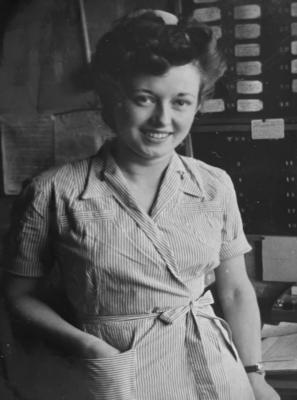
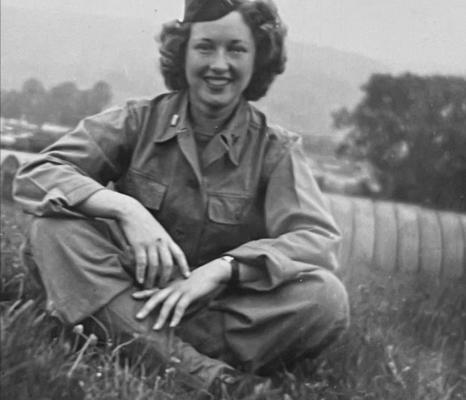
After the traveling over seas by boat, Lucille and her nurse companions as well as the entire 279th Station Hospital was set up in valley of Mount Abergavenny, the Gateway to Wells. It was a pleasant country town at the feet of three mountains: the Sugarloaf, Blorenge and Skirrid. Abergavenny had two railroad stations and a bus station. There were lots of places to visit.
“I did not drink or smoke so all of my free time I saved up for traveling. We went lots of places in Europe,” Jarrell commented. The nurses also hiked into the mountains. A brochure from when they were in Wales details the mountains they would climb. Excerpt typed below.
“WALKING AROUND ABERGAVENNY”
To climb Skirrid Fach (Little Skirrid 866 feet) cross the footbridge at the G.W.R. station, continue south for 160 yards and then along by hedge and water course. You will find a path between wire fences which leads to the summit.
Skirrid Fawr (Great Skirrid 1,601 feet) is known as the "Holy Mountain" because of a deep fissure and precipice caused by a landslip which is said to have occurred on the night of the Crucifixion.
Blorenge (Blue Ridge 1,832 feet ismore difficult to climbthan Great Skirrid because the route lies over soft ground.
Sugar Loaf (1,955 feet) is so called because of its conical shape. Except for the last 500 feet, the climb is not difficult, and from the town to the summit is about 2 miles. At the summit a fine view of the Bristol Channel and the Malvern Hills is possible on a clear day.”
In Abergavenny, the hospital was completely set up and Lucille and her fellow nurses were trained and prepared for the coming war. She writes about this time in her journal.
“Black out curtains were used on all windows so no light would be seen from the outside. Also you weren’t allowed to carry a flashlight without a color filter over the bulb. You learned to more or less travel in the dark.
Immediately after D-day we started receiving casualties from the battlefront within 24 to 48 hours after they were injured. The hospital train would arrive twice a week at 3 AM. We were all awakened and then reported for duty and would work until all patients were taken care of; often until 10 or 11 PM
After D-Day it was days of blackouts and gas masks. We nurses required to carry our own gas mask with us at all times. We had air raids often and whether day or not we would report to the hospital. German planes would fly over our hospital and even dropped flares but the closest a plane was shot was about 3 miles away. You learned to recognize the sound of an enemy plane and it would often awaken you before the air raid sirens even sounded. Each night before lots out nourishment was served. Hot chocolate was a favorite so large amounts of hot chocolate were made out of powdered milk which was not like the powdered milk we have today. It took quite a while to get it to dissolve. Also after the snow started following we would make snow ice cream.
We kept some of our patience in the orthopedic awards as long as a month through longer. Or they were sent to the general hospital in the states as soon as they were well enough to travel. The tent patients were sent back to active duty or to a lesser as they were able. We heard from so many that stayed so long. They would write back to us. It was all like a big family. We were there sisters and they were our brothers.
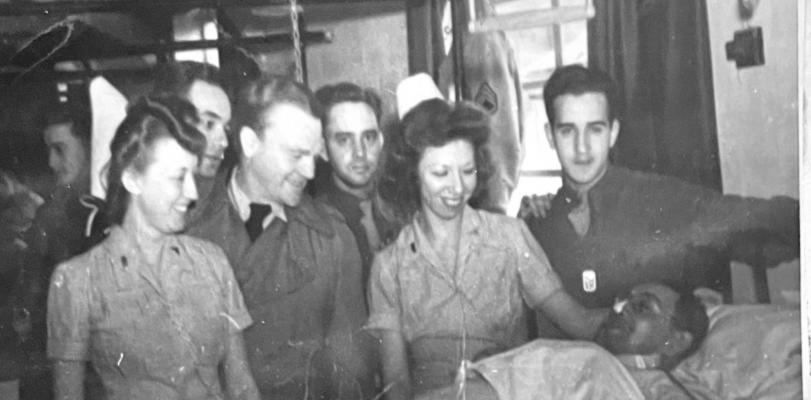
James Cagney the actor visited every ward. When he visited ours he said we were the prettiest girls he had had ever had his picture taken with. I couldn’t wait to tell Lorita. But he had told her and all the rest of them the same little story. That tickled us. He offered to sign autographs and I still have the money he signed for me. I’m also pictured with him in this photo.”
Visiting with Mrs. Jarrell is like stepping back in time. It is clear from her stories and the many drawings and cards she has saved from Ward 38, she was dearly loved by her patients and fellow nurses, as well as the doctors and army superiors. Getting to know a small portion of her story has brought myself and many others, especially nurses and ladies in the military, great joy.